
Hi, Good Morning (Dynamic)
I am Roydon
Engineer
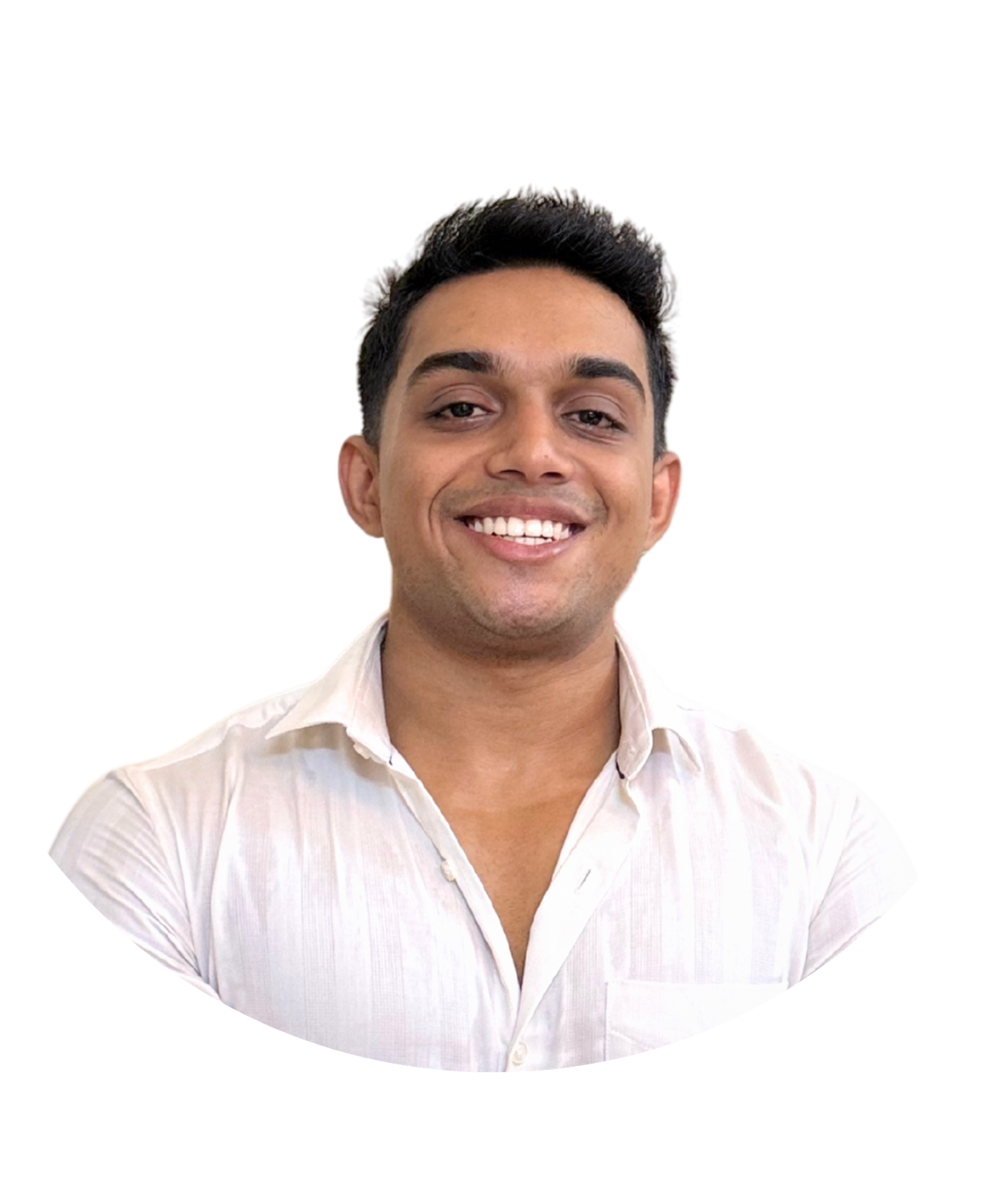
About me
AI & Machine Learning Engineer specializing in Generative AI systems, autonomous AI agents, and intelligent
automation platforms.
I previously worked as a GenAI Engineer at ReinHealth.ai, where I designed and built production-grade medical
AI agents and AI-powered automation pipelines used in real-world healthcare workflows.
My work focuses on building AI systems that combine large language models, vector retrieval, backend
infrastructure, and workflow automation to solve practical problems. I am particularly interested in agentic AI
architectures, LLM-based tool orchestration, and Retrieval-Augmented Generation (RAG) systems designed for
reliable and scalable environments.
AI & MACHINE LEARNING
 GENERATIVE AI
AI & MACHINE LEARNING
GENERATIVE AI
GENERATIVE AI
AI & MACHINE LEARNING
GENERATIVE AI
Personal Info
GenAI Engineer focused on building production-grade AI agents, RAG pipelines, and healthcare
automation systems.
I have over 20 months of professional experience at ReinHealth.ai, where I worked on autonomous
medical AI agents and AI-powered clinical workflows used in real-world healthcare environments.
- Name Roydon Sequeira
- Location Udupi, India
- Email roydnsequeira@gmail.com
- Education B.E. in AI & ML (2020-2024)
- Languages English, Hindi, Kannada, Tulu
Experience
GenAI Engineer
Jul 2024 – Feb 2026
ReinHealth.ai (Stealth Healthcare Startup)
Role Overview
At ReinHealth.ai, I worked as a core GenAI Engineer responsible for designing, building, and productionizing AI-driven healthcare systems, with a strong focus on autonomous AI agents, clinical workflows, and AI-powered automation. My role combined AI system architecture, backend engineering, and workflow automation, operating in a real-world healthcare context where accuracy, data integrity, and reliability were critical.
Primary Responsibilities & Contributions
Autonomous Medical AI Agent Development
- → Led the end-to-end design and implementation of Areya, an advanced medical AI agent capable of conducting structured, doctor-like conversations with patients through both text and voice interfaces.
- → Architected agentic reasoning flows where
the AI dynamically:
- • Analyzes user intent and symptoms
- • Asks medically relevant follow-up questions
- • Selects and executes appropriate tools
- • Synthesizes clinically grounded responses
- → Implemented Retrieval-Augmented Generation (RAG) pipelines using vector databases to ensure responses were context-aware and grounded in stored patient data and medical knowledge.
- → Integrated local LLM inference to reduce dependency on external APIs and improve privacy for healthcare use cases.
- → Designed safety-oriented logic such as emergency symptom detection, escalation cues, and conservative response strategies.
Healthcare Data & Backend Systems
- → Designed backend services to support patient records, clinical interactions, and AI outputs, using structured databases alongside vector storage.
- → Implemented semantic embeddings for patient data and historical interactions, enabling similarity-based retrieval and contextual continuity.
- → Ensured strong data validation, consistency checks, and audit logging, aligned with healthcare system expectations.
- → Built APIs to connect AI agents, automation workflows, and frontend interfaces into a cohesive system.
AI-Powered Workflow Automation (n8n)
- → Architected and implemented production-grade n8n workflows to automate key healthcare operations, making AI systems operationally useful beyond chat-based interactions.
- → Designed intelligent appointment management workflows that handled booking, rescheduling, cancellation, conflict detection, and confirmation messaging.
- → Built clinical documentation automation
pipelines, including:
- • Speech-to-Text (STT) workflows converting physician audio into structured clinical notes
- • Text-to-Text (TTT) workflows transforming raw clinical text into standardized medical documentation
- • Text-to-Speech (TTS) workflows generating professional audio summaries of clinical notes
- → Integrated n8n workflows tightly with
databases, AI reasoning chains, and validation logic, ensuring:
- • No fabricated medical data
- • Exact preservation of critical values (e.g., vitals)
- • Structured, repeatable outputs suitable for clinical environments
- → Implemented robust error handling, retries, and logging, making workflows reliable under real operational conditions.
System Reliability & Production Readiness
- → Focused on building production-ready AI systems, not experimental prototypes.
- → Designed systems with:
- • Graceful degradation and fallback logic
- • Clear separation of concerns between AI reasoning, data access, and automation
- • Scalability considerations for concurrent usage
- → Collaborated closely with product and technical stakeholders to align AI behavior with real healthcare workflows.
Impact
- ✓ Delivered a fully functional medical AI agent capable of autonomous, structured healthcare conversations.
- ✓ Reduced manual clinical workload through AI-driven automation pipelines.
- ✓ Demonstrated how LLMs, agents, databases, and workflow automation can be combined into a single, coherent healthcare platform.
- ✓ Established a strong foundation for scalable, privacy-aware, AI-powered healthcare solutions.
Machine Learning Intern
Jun 2023 – Jul 2023
Igeeks Technologies – Bangalore, India
Role Overview
Worked on practical computer vision and machine learning tasks in a collaborative team environment, focusing on image-based classification systems and model development.
Key Contributions
- → Developed and trained image classification models using classical ML algorithms and deep learning architectures.
- → Built and refined custom datasets, including image preprocessing, augmentation, and normalization for model training.
- → Implemented models using CNNs, AlexNet, and Multilayer Perceptron (MLP) architectures.
- → Applied OpenCV for image processing tasks such as feature extraction, transformation, and segmentation.
- → Utilized NumPy and Python-based tooling for data manipulation and model input pipelines.
- → Conducted model training, evaluation, and iterative performance improvements through parameter tuning.
Technologies Used
Python, OpenCV, NumPy, CNN, AlexNet, MLP, classical ML algorithms
TECH STACK
AI & Generative AI Systems
- LLMs
- Agentic AI
- RAG Pipelines
- Prompt Engineering
- Semantic Search
Backend & AI Application Development
- Python
- Flask
- REST APIs
- AI Application Architecture
Data & Vector Infrastructure
- PostgreSQL
- Qdrant
- Vector Databases
- Embeddings
AI Systems & Infrastructure
- Docker
- Ollama (Local LLM Inference)
- STT/TTS Pipelines
- n8n Workflows
- End-to-End AI Pipelines
 20+ Months Professional Experience
4+ Years Coding Experience
Healthcare AI Systems
Autonomous AI Agents
Production-Grade Solutions
20+ Months Professional Experience
4+ Years Coding Experience
Healthcare AI Systems
Autonomous AI Agents
Production-Grade Solutions
FEATURED PROJECTS
Areya – Advanced Medical AI Agent
Areya is an advanced medical AI agent designed to simulate structured, doctor-like conversations with patients. The system combines LLM reasoning, medical knowledge retrieval, and workflow orchestration to provide context-aware, clinically grounded responses through both text and voice interfaces.
Tech Stack
LangChain
Ollama
Qdrant
Flask
PostgreSQL
STT/TTS
Role: GenAI Engineer and System Architect
Status: Production-ready
Domain: Healthcare AI, Autonomous Agents
Overview
Areya is an advanced medical AI agent designed to simulate structured, doctor-like conversations with patients. The system combines LLM reasoning, medical knowledge retrieval, and workflow orchestration to provide context-aware, clinically grounded responses through both text and voice interfaces.
Problem
Healthcare systems require AI solutions that can:
- → Interact naturally with patients
- → Ask medically relevant follow-up questions
- → Retrieve trusted medical knowledge
- → Maintain patient context and data integrity
Solution
Areya was built as an autonomous agent system that:
- → Analyzes user queries
- → Selects appropriate tools (search, retrieval, database queries)
- → Synthesizes responses using local LLMs
- → Applies medical constraints and safety checks
Key Capabilities
- → Structured medical questioning (symptoms, history, severity)
- → Tool-based reasoning and decision flow
- → Multimodal interaction (voice ↔ text)
- → Emergency symptom detection and escalation logic
- → Patient data storage with semantic retrieval
Technical Architecture
- → LLM & Agents: LangChain, local LLMs via Ollama
- → Knowledge Retrieval: Qdrant vector database
- → Backend: Flask-based REST API
- → Data Layer: PostgreSQL (structured medical records)
- → Voice: Speech-to-Text and Text-to-Speech pipelines
Impact
- → Enabled autonomous clinical-style interactions
- → Reduced dependency on external LLM APIs
- → Provided a scalable foundation for AI-driven healthcare platforms
Clinical Automation Workflows (n8n)
A production-ready suite of AI-powered automation workflows designed to streamline clinical operations and medical documentation. The system uses n8n workflow orchestration, LLM-based prompt chains, and strict data validation to automate appointment management, clinical note generation, and medical documentation across multiple modalities.
Tech Stack
n8n
LLM
Chains
PostgreSQL
STT/TTS
Role: AI Automation Engineer
Status: Production-ready
Domain: Healthcare Operations & Automation
Overview
A suite of AI-powered automation workflows built using n8n to streamline clinical operations, reduce manual workload, and ensure structured medical documentation.
Workflows Implemented
A. Intelligent Appointment Management
- → Natural-language appointment booking, rescheduling, and cancellation
- → Conflict detection and time-slot validation
- → Database-backed audit trails
B. Speech-to-Text Clinical Notes
- → Converts doctor audio recordings into structured clinical notes
- → Ensures exact transcription of vital signs
- → Outputs standardized medical note formats
C. Text-to-Text Clinical Notes
- → Transforms raw clinical text into structured documentation
- → Faster alternative for typed inputs
- → Maintains clinical consistency and validation rules
D. Text-to-Speech Clinical Summaries
- → Converts structured medical notes into professional audio summaries
- → Useful for physician review or patient communication
Technology Stack
- → Automation: n8n
- → AI Reasoning: LLM-based prompt chains
- → Database: PostgreSQL
- → Voice Services: STT & TTS APIs
- → Validation: Strict medical data integrity rules
Impact
- → Reduced documentation time
- → Improved consistency of clinical records
- → Demonstrated seamless AI + automation integration
Skin Lesion Segmentation & Monitoring
Medical image analysis system focused on accurate lesion identification and monitoring using deep learning. Implements U-Net and ResUNet architectures for precise pixel-level segmentation to support early skin cancer screening.
Tech Stack
Python
TensorFlow/Keras
OpenCV
Streamlit
U-Net
& ResUNet
Project Overview
Skin Lesion Segmentation is a medical image analysis project focused on accurately identifying and isolating skin lesion regions from dermoscopic images using deep learning–based semantic segmentation. The project implements and compares U-Net and ResUNet architectures to achieve precise pixel-level segmentation, a critical preprocessing step in computer-aided dermatology and early skin cancer screening systems.
Problem Statement
Manual delineation of skin lesions by clinicians is time-consuming, subjective, and prone to inter-observer variability.
Automated segmentation is challenging due to:
- → Irregular lesion boundaries
- → Low contrast between lesion and surrounding skin
- → Hair, noise, and illumination artifacts
- → Large variation in lesion size, color, and texture
The goal is to build a reliable deep learning system that accurately segments lesion regions and supports quantitative lesion analysis.
Dataset
Source: ISIC 2018 Skin Lesion Dataset
Samples: 2,596 dermoscopic image–mask pairs with expert-labeled binary segmentation masks.
Challenges Addressed: High intra-class variability, hair occlusions, fuzzy lesion boundaries.
Images were preprocessed and resized to a fixed resolution to ensure consistency during training.
System Architecture
U-Net Architecture
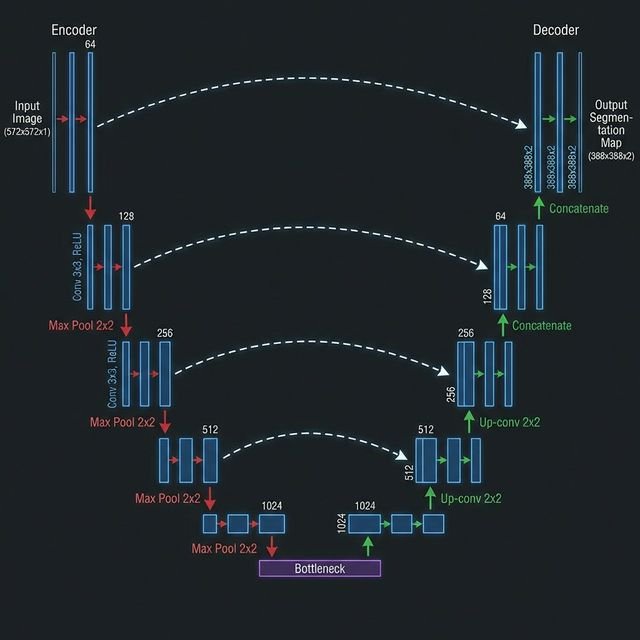
The baseline model uses a U-Net encoder–decoder architecture:
- → Encoder captures contextual features through progressive downsampling
- → Decoder restores spatial resolution through upsampling
- → Skip connections preserve fine-grained spatial details
- → Final 1×1 convolution produces a binary segmentation mask
ResUNet Enhancement
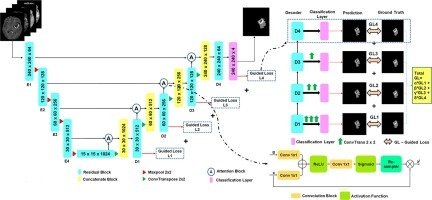
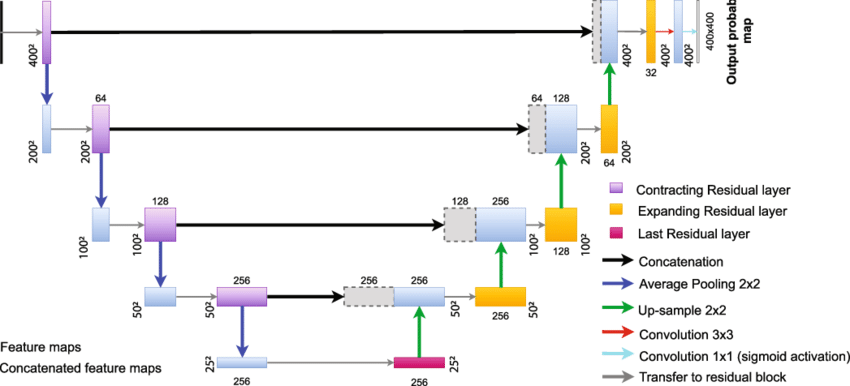
To improve training stability and segmentation quality, the baseline U-Net was extended to ResUNet by introducing residual connections.
Why ResUNet:
- → Improves gradient flow in deeper networks
- → Reduces vanishing gradient issues
- → Enables better learning of fine lesion boundaries
- → Stabilizes training on limited medical datasets
Training Pipeline
- → Input: 256 × 256 dermoscopic images
- → Optimizer: Adam
- → Loss Function: Dice Loss
- → Hardware: GPU-accelerated (CUDA)
Evaluation Metrics
Segmentation performance was evaluated using domain-appropriate metrics:
- → Dice Coefficient
- → Intersection over Union (IoU / Jaccard Index)
- → Precision, Recall, F1-score
- → ROC–AUC
Qualitative Results
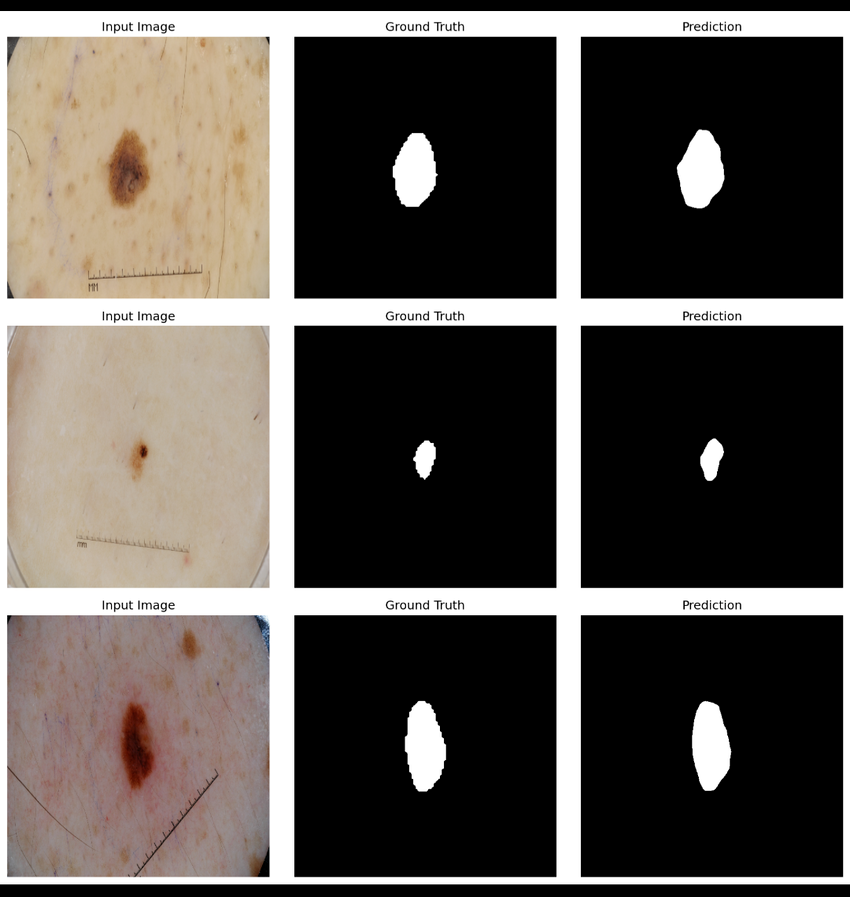
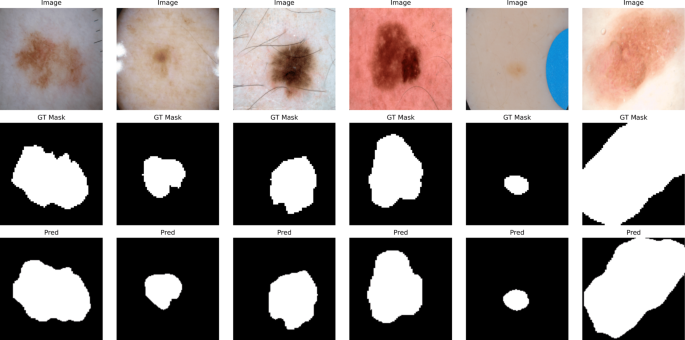
Visual observations confirm accurate lesion boundary detection, reduced false positives, and improved handling of irregular edges. ResUNet produces smoother and more consistent masks compared to the baseline U-Net.
Quantitative Lesion Analysis
Beyond segmentation, the system performs quantitative analysis:
- → Lesion area computation
- → Width and height estimation
- → Contour extraction using predicted masks
- → Baseline vs current lesion comparison
Interactive Inference
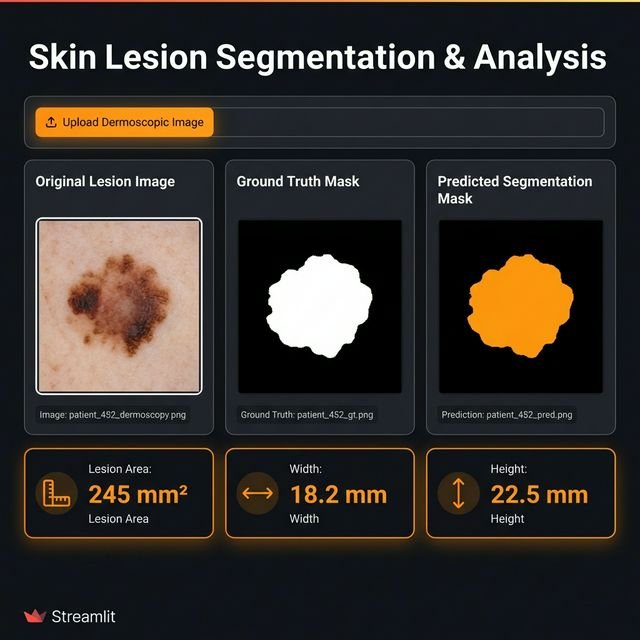
Interactive Streamlit Application Interface
Image Upload
Drag & drop dermoscopic images for analysis
Real-Time Segmentation
Instant U-Net/ResUNet inference with visual masks
Quantitative Metrics
Area, width, height, and comparison tracking
Fully functional web interface for clinical lesion monitoring and analysis
An interactive Streamlit application allows users to upload custom dermoscopic images, perform real-time inference, and visualize segmentation masks along with lesion measurements.
Summary
Designed and implemented U-Net and ResUNet models for automated skin lesion segmentation, enhanced with residual connections for stability and accuracy. Evaluated using industry-standard metrics and deployed via an interactive Streamlit application for real-time inference and clinical analysis.
SERVICES
I help startups, healthcare platforms, and businesses design and deploy production-grade AI systems that automate workflows, enhance decision-making, and enable intelligent software products. My work focuses on Generative AI, autonomous agents, and AI-driven automation systems built using modern machine learning and software engineering practices.
01
AI Agent Development
Autonomous AI systems capable of reasoning, tool usage, and multi-step task execution.
02
Custom AI Chatbots & Knowledge Assistants
AI chat systems trained on your own business data.
03
AI Workflow Automation
End-to-end automation of complex business workflows using AI.
04
Private AI Knowledge Systems (RAG)
Secure AI systems trained on internal company data.
05
AI Backend & API Development
Production-grade infrastructure for AI-powered applications.
06
Healthcare AI & Medical Automation
AI solutions tailored for healthcare workflows and medical data systems.
Interested in working together? Let's talk about your project.
Get In TouchACADEMIC BACKGROUND
B.E. in Artificial Intelligence & Machine Learning
- NMAM Institute of Technology
- 2020 – 2024
- Specialized in AI, ML, and GenAI
- Focus on autonomous systems and intelligent agents
CERTIFICATIONS & ONGOING LEARNING
Executive PG Certification in Data Science & AI
- IIT Roorkee
- Status: Ongoing
- Advanced Data Science techniques
- AI system architecture and deployment
Ultimate Data Science & GenAI Bootcamp
- Krish Naik Academy
- Status: Ongoing
- Comprehensive GenAI training
- LLM applications and deployment